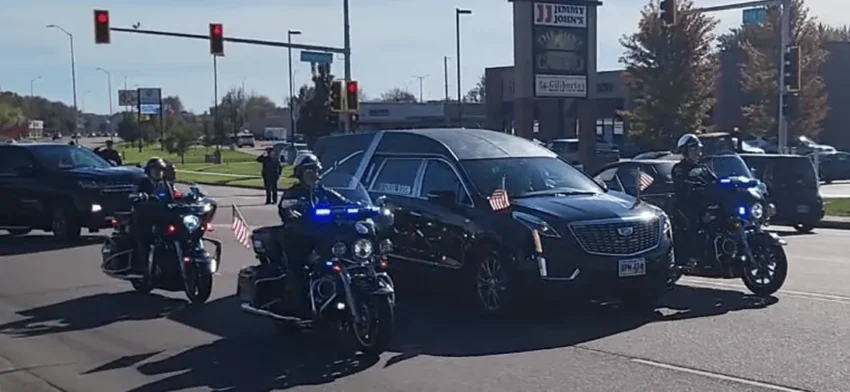
SIOUX FALLS, SD — Hundreds of first responders filled Monday’s funeral for Minnehaha County Sheriff’s Deputy Katherine Frank, with mourners traveling from across the nation to stand with her family and colleagues. The gathering reflected how far the impact of her death reached within law enforcement, as agencies from multiple states sent officers and deputies to Sioux Falls.
Those who attended said they came not only to honor Frank, but also to show support for the department and community she served. For many in uniform, the loss felt personal even if they had never met her. Officers described the funeral as a shared moment of grief, because they understand the pressures, risks, and emotional weight that come with police and deputy work.
Officers say the loss resonates far beyond one department
Several law enforcement officers said Frank’s death struck a nerve because the job carries a common set of hardships. Columbus police Commander Dave Hughes said officers and deputies are often the people called on during someone’s worst day, and that can make a line-of-duty death especially painful for those left behind.
Samuel Gustafson of the Nebraska State Patrol said the stresses of law enforcement, including nights away from home and traumatic calls, are shared across agencies. McCook County Sheriff’s Deputy Tim Simmermon also described Frank’s death as a major loss at a time when recruiting and retaining good officers is already difficult. In his view, communities depend on people willing to step up for public safety.
Ty Reinke of the Aberdeen Police Department said he has attended other funerals for officers killed in the line of duty, including memorials for an officer in Fargo and another in Grand Forks. He said those services are especially hard when the fallen officer is young, because they make the risks of the profession impossible to ignore.
Traveling support reflects a wider law enforcement bond
Some of the officers who attended Monday’s service said they came from departments that know what it means to lose one of their own. Hughes said he has buried 13 officers during his time with the Columbus Police Department, and that experience made him want to be present for Frank’s family and coworkers in Sioux Falls.
Others said the decision to attend was simple because neighboring agencies often work closely together. McCook County Deputy Sheriff Hayley Mayou noted that her office works next to Minnehaha County and knows many of the deputies there. She said showing up for the funeral was important as a sign of solidarity during a painful time.
That sense of fellowship was visible in the size and reach of the turnout. First responders said the law enforcement world is close-knit, and when one department grieves, others often rally around it. For many attending Monday’s service, their presence was meant to say that Frank’s death was felt well beyond one county line.
Public sympathy and community support help mourners cope
First responders said support from the public has been an important part of processing the tragedy. Tim Simmermon said the outpouring of sympathy can help people move through the emotional toll that follows a loss like this, especially when the grief is shared across entire agencies and families.
Hughes compared that response to an emergency call, saying it was as though the Minnehaha County Sheriff’s Office had called 911 and the community had answered. The comparison captured how many law enforcement officers view public support: not as a gesture from the sidelines, but as a direct form of help during a crisis.
That kind of response can matter in the days after a death, when the grief is still fresh and routines have been interrupted. Officers at the funeral said the presence of ordinary citizens and fellow first responders alike helped show that Frank’s service and sacrifice were recognized by people far beyond her own department.
Shrines, patches, and memorial signs outside the Premier Center
Outside the Premier Center, departments from as far away as Rapid City and Chicago left their patches at a shrine dedicated to Frank. The display became a visible sign of respect from agencies across different regions, all recognizing the significance of her death in the line of duty.
Those patches, along with the large turnout for the funeral, showed how memorial traditions can help departments honor fallen officers while also giving mourners a place to express grief. For many who attended, the shrine offered one more way to mark the loss and stand with the Minnehaha County Sheriff’s Office.
The memorial outside the venue also reinforced how the funeral reached beyond a single service or county. It became a gathering point for people who understood the emotional burden of police and deputy work and who wanted to make clear that Frank’s family and coworkers were not facing the day alone.
A funeral that underscored the risks officers share
The funeral for Deputy Frank highlighted how line-of-duty deaths can reverberate through the broader public safety world. Even officers who never worked alongside her said they felt the loss because the profession creates a bond built on common experience, sacrifice, and the possibility of tragedy.
For many in attendance, the service was about more than remembrance. It was also a reminder of the demands placed on people in uniform, from late-night calls to the emotional strain that follows them home. That shared reality is part of why agencies from several states sent people to Sioux Falls.
By the time the funeral ended, the message from those gathered was clear: Frank’s death affected far more than one department. The size of the turnout, the words of officers from around the country, and the shrine outside the center all pointed to a wider law enforcement community grieving together.