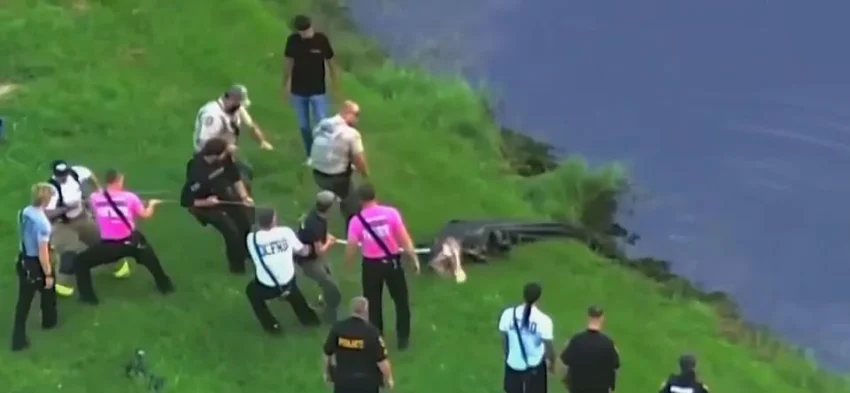
WINTER GARDEN, FL — A Florida fisherman was photographed just moments before an alligator attack killed him at Lake Apopka, turning an ordinary outing into a fatal encounter. Steven Hamilton, 71, had just caught a large bass and was posing for a picture near the water at Dr. Bradford Memorial Park when the reptile surfaced, according to a witness who was with him.
Jason Handley, a local landscaper who knew Hamilton, said the alligator appeared to go after the fish. He said Hamilton heard the animal emerge from the lake, tried to run, slipped, and was seized by the gator before being dragged into the water. The attack happened on Friday, Oct. 16.
Witnesses say the attack happened beside the shoreline
Handley said Hamilton was standing only about five feet from the water when the animal came up. In his account, Hamilton reacted quickly after hearing the gator surface, but lost his footing during the scramble away from the edge.
That brief moment was enough for the alligator to grab him and pull him underwater, Handley said. Onlookers responded by throwing traffic cones at the animal in an effort to interrupt the attack, but those attempts did not force the reptile to let go.
The scene unfolded at Lake Apopka in Winter Garden, a place where alligator sightings are not unusual. Even so, attacks on people are considered uncommon in Central Florida, where many residents and visitors regularly encounter the animals near lakes, canals and wetlands.
Medical examiner ruled the death an accident
A medical examiner later determined that the alligator seized Hamilton by his left leg. His death was ruled an accident caused by drowning and blunt force injuries, according to the findings described in the account of the case.
The forensic review also indicated that Hamilton was still alive when he was taken underwater. It said the alligator briefly surfaced with him still in its jaws before submerging again, a detail that underscored how quickly the attack turned fatal.
Those findings added grim clarity to what witnesses saw at the shoreline. Hamilton had gone from posing for a photo with his catch to fighting for his life in a matter of moments.
Emergency crews faced dangerous conditions in the water
Emergency personnel reached the park quickly, but the response was complicated by the presence of other aggressive alligators in the area. Rescue swimmers were not able to enter the water right away because of the danger posed by the animals gathered nearby.
Hamilton’s body was recovered about two hours later. The delay reflected the risks responders faced in trying to reach the victim while remaining safe themselves.
The circumstances also showed how quickly a search can become hazardous in alligator country. Even after the initial attack, the water remained too dangerous for a direct recovery attempt until crews could proceed more safely.
A nuisance trapper later killed the alligator
A licensed nuisance alligator trapper working with the Florida Fish and Wildlife Conservation Commission later located the animal believed to have been involved in the attack. The trapper then killed the alligator soon afterward.
That step is a standard part of some dangerous wildlife incidents in Florida, where officials may remove or destroy an animal after a serious attack. In this case, authorities moved after the recovery effort and identification of the reptile near the park.
The response closed the immediate chapter of the incident, but it did little to change the fact that a routine fishing trip had ended in tragedy for Hamilton and the people who saw what happened.
Lake Apopka is familiar territory for anglers and alligators alike
Handley said he frequently fishes at the same lake and described the spot as one where aggressive alligators can come close to people. He said he had spoken with Hamilton there before while fishing, and warned that the animals would sometimes approach very near the shoreline.
Lake Apopka and the surrounding parkland are part of a landscape where human activity and wildlife often overlap. That does not make attacks routine, but it does mean people fishing, walking or working near the water are often reminded to keep their distance from the edge.
Hamilton’s final photo, taken with the bass moments before the attack, captured the calm just before the violent encounter. For those at the scene, it became the last image of a day that changed in seconds.