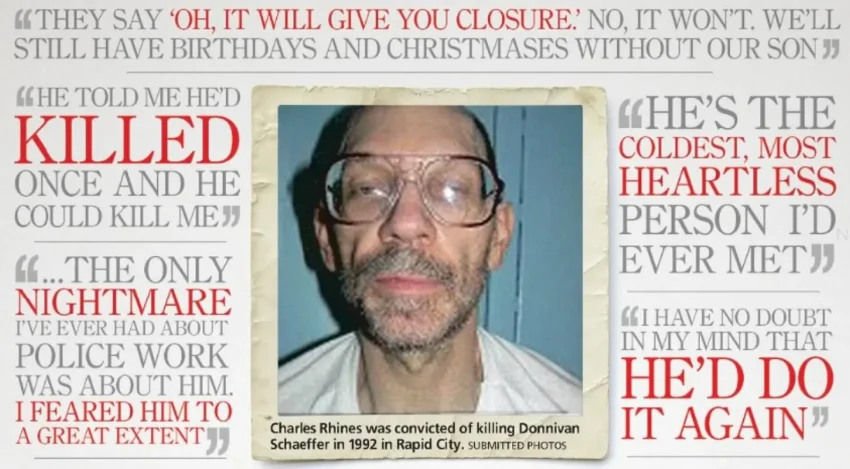
RAPID CITY, SD — Charles Rhines was executed in South Dakota after spending more than two decades on death row for the killing of a former co-worker during a burglary at a Rapid City doughnut shop in 1992. Prosecutors said Rhines entered the Dig ‘Em Donuts office before opening hours with a duplicate key, expecting to steal cash. Instead, he confronted Donnivan Schaeffer and fatally stabbed him during the robbery.
Rhines was 63 when he was put to death, becoming the 1,508th person executed in the United States and only the fifth person executed by lethal injection in South Dakota since 1976, according to the Marshall Project. The case drew attention for its violence, the lengthy appeals that followed, and Rhines’ claims that jurors were biased against him because he was gay.
How a burglary at Dig ‘Em Donuts turned into a killing
The crime unfolded in the shop office just before dawn on March 8, 1992. Rhines had been fired three weeks earlier, but he had already made a duplicate key, which let him walk in without forcing his way inside. He found cash and was in the middle of the burglary when the office door opened and Schaeffer unexpectedly entered.
Rhines later told police in a recorded confession that he first thought he had seen another man. By the time he realized the person on the floor was Schaeffer, he had already stabbed him. Pennington County State’s Attorney Dennis Groff said at trial that Schaeffer fell to the ground “kicking and screaming in pain.”
Schaeffer pleaded for his life and for help, according to testimony and Rhines’ confession, but Rhines did not call for medical aid. Instead, he stabbed Schaeffer again and later moved him into a storage room, where the assault continued.
What prosecutors said happened after Schaeffer was wounded
According to the trial account, Rhines bound Schaeffer’s hands behind his back, leaned him forward on a wooden pallet and drove the knife into the back of his neck and skull. Groff said Schaeffer, who was 22 and planning to marry, died immediately from the attack.
After the murder, Rhines finished the robbery and took about $1,700 in cash from the shop. He then discarded the hunting knife and checks in a ditch. The violent sequence, prosecutors argued, showed the killing was tied directly to the burglary rather than a panic response to being caught.
Rhines’ roommate, Sam Harter, later picked him up after dropping him off at the shop. According to reporting cited in the case, Harter saw Schaeffer’s body only afterward. Rhines allegedly threatened to kill Harter’s family if he turned him in, and the two later attended Schaeffer’s funeral together.
Police tracked Rhines to Seattle and recorded his confession
Rapid City police followed Rhines until he was arrested in Seattle. Chief Steve Allender said Rhines eventually gave a recorded confession and described him as one of the most disturbing suspects he had encountered in decades of law enforcement work. Allender said the case stayed with him for years because of how calmly Rhines spoke about the killing.
At one point during the interview, Allender recalled, Rhines broke into a loud laugh that stood out from his otherwise measured tone. Investigators later treated that moment as part of the evidence that helped persuade a jury to impose a death sentence. The confession became a central piece of the state’s case.
Rhines was convicted and sentenced to death in South Dakota, where the state did not maintain a traditional dedicated death row. Instead, he spent years in segregated custody under severe restrictions while the legal fight over his sentence continued.
Life in restrictive custody while appeals dragged on
For more than 20 years, Rhines lived apart from other prisoners in a mesh cage-like area and was not allowed physical contact with anyone. He was locked down for 23 hours each day and received one hour of recreation time. His routine was tightly controlled from morning through night.
According to accounts of his daily schedule, breakfast came around 6:30 a.m., followed by coffee and CNN on a small television. Lunch was served at 10:30 a.m., then recreation while handcuffed, showers, and a return to his cage for reading, crossword puzzles and beadwork crafts. Lights went out at 11 p.m.
The conditions reflected South Dakota’s approach to death-sentenced prisoners and underscored how long Rhines remained in state custody while lawyers pursued repeated challenges to his conviction and punishment. The time between the crime and the execution stretched across more than a generation.
Rhines argued the jury was biased against him because he was gay
Rhines filed multiple appeals contending that his sexual orientation influenced the jury’s decision-making. He also wrote letters, some of which were published in 2014, saying jurors had sent questions to Judge John Konenkamp, who has since retired from the South Dakota Supreme Court.
Rhines said at least three of those questions focused on whether he would be housed alone or with a cellmate if he were imprisoned for life. Those questions were not answered. In his view, that showed the jury was weighing his sexuality after promising not to consider it.
The South Dakota Supreme Court rejected that argument in 1996, saying any improper admission would have amounted to harmless error because the evidence against him was overwhelming. Court documents said Rhines confessed to the burglary and murder four times, including once to a young woman and three times to law enforcement officers.
Final statement before the lethal injection
Before the execution, South Dakota Secretary of Corrections Mike Leidholt asked Rhines whether he had any final words. Rhines used the moment to address Schaeffer’s parents, Edwin and Peggy Schaeffer, and said he forgave them for their anger and hatred toward him.
He also thanked his legal team and the supporters who stayed with him through the end. Rhines ended by saying goodbye and telling officials to proceed. The execution closed a case that had begun with a burglary in a doughnut shop office and had spent decades moving through the courts, appeals and prison restrictions before ending with a lethal injection in South Dakota.
The killing of Donnivan Schaeffer remained central to the case from beginning to end. For prosecutors, police and Schaeffer’s family, the 1992 robbery and murder never became just another old crime file; it stayed a defining case in South Dakota’s modern death-penalty history.